

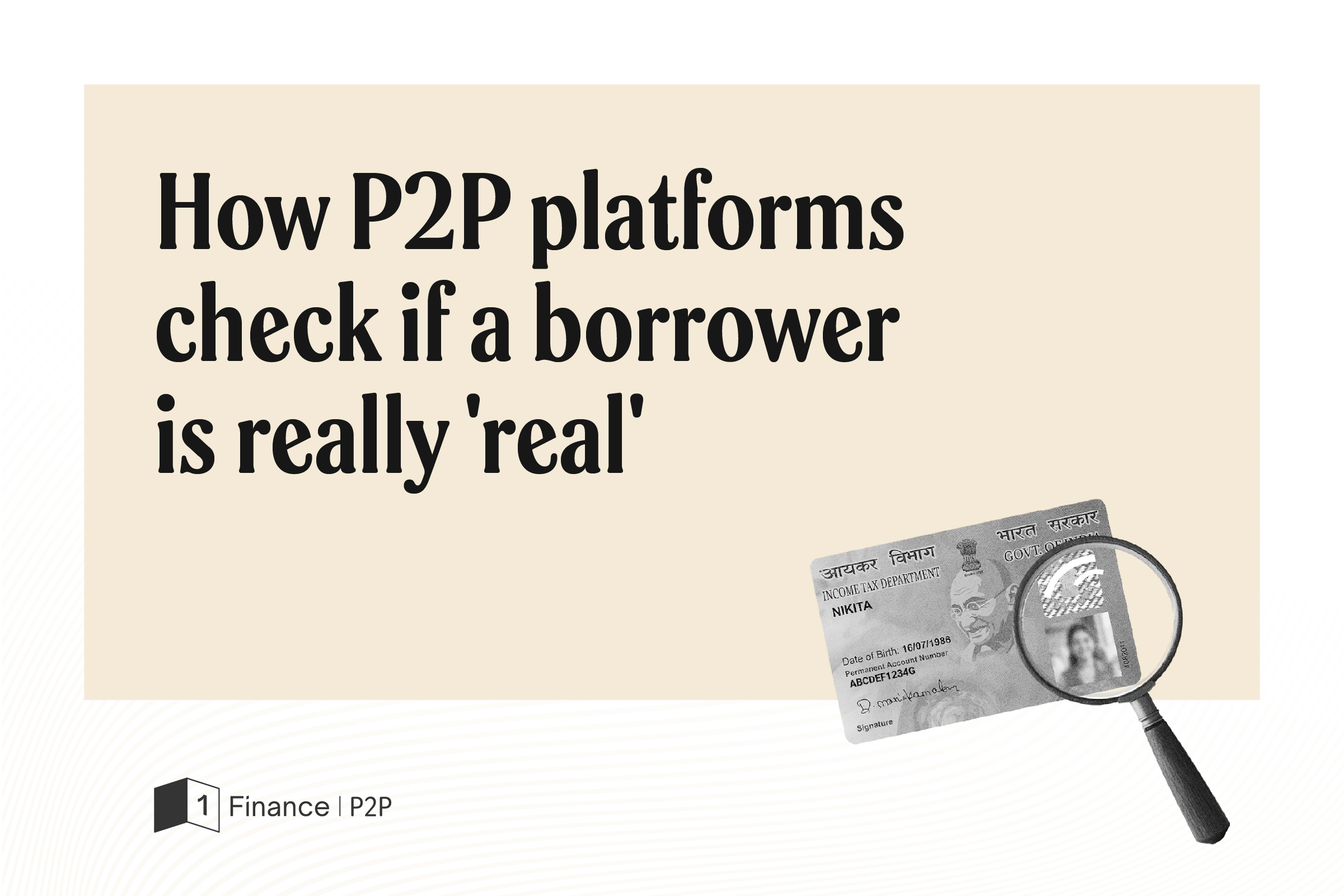
Lending money through an online app to a borrower, who’s a stranger to you, needs a degree of trust. Reviewing the borrower’s complete profile, along with the interest offered, still leaves your decision resting on how reliably the borrower has been assessed. The person behind the profile may not always be who they claim to be, which makes borrower identity verification critical. It gives lenders a more reliable basis for knowing who they are actually lending to.
Fraudsters know that online lending can attract people looking to put their surplus money to work, and the regulator knows it too. In response, the RBI has strengthened the rulebook for P2P lending platforms in India, first through its Master Direction of 2017 and again through amendments in August 2024. For lenders, this makes the checks performed before a borrower enters the P2P ecosystem an important part of the lending process.
What does borrower identity verification mean on a P2P lending platform?
Borrower identity verification is the process that confirms every loan applicant is a real, traceable person with a verifiable financial history. These checks are anchored in a framework mandated under the RBI’s KYC Master Direction of 2016.
Borrower identity verification covers three layers on a well-run platform. The platform confirms the borrower’s identity, checks the authenticity of their submitted documents, and do they support the P2P loan they’ve applied for.
This screening is imperative for you as a lender, because a default caused by fraud is harder to trace and recover than one caused by ordinary financial stress.
Which RBI rules govern borrower verification on P2P lending platforms in India?
Every legitimate P2P lending platform in India operates as an NBFC-P2P, a non-banking financial company licensed by the RBI for this specific business. The RBI Master Direction of 2017 requires P2P platforms to undertake due diligence on all participants, carry out credit assessment and risk profiling of borrowers, and disclose those results to prospective lenders. They also need the borrower's prior and explicit consent before accessing their credit information.
The amendments notified on 16 August 2024 tightened the framework after the RBI observed violations across the sector. P2P lending platforms now carry no credit risk on transactions, and any loss of principal or interest rests solely with lenders. The platforms must also publicly disclose portfolio performance on their websites, including the share of non-performing assets (NPAs) and losses incurred by lenders.
Weak borrower screening became a compliance liability once these disclosures turned public and monthly.
Which checks a borrower needs to clear to become eligible for a P2P loan?
Borrower identity verification runs in sequence, and an applicant who fails any stage mustn’t make it to the list. The stages below apply on RBI-regulated P2P platforms.
- Document checks: Borrowers submit an officially valid document such as Aadhaar, passport, driving licence, or voter ID, along with PAN, and platforms test these for authenticity.
- Video KYC: Some P2P platforms perform video KYC, conducted in real time by a trained employee, with the full session recorded.
- Credit bureau screening: An NBFC-P2P must become a member of all four credit information companies (CIC) and submit borrower data to them, updated at least monthly. Bureau records expose past defaults and current loans across the financial system.
- Income and repayment assessment: Credit assessment and risk profiling of every borrower is a regulatory obligation. Platforms commonly examine bank statements, income proof, and EMI repayment history at this stage.
- Bank-account-only money movement: All fund transfers must flow through escrow accounts overseen by a bank-promoted trustee, and cash transactions are strictly prohibited. Every borrower therefore holds a bank account that has already cleared a bank's own KYC.
Which fraud patterns do P2P lending platforms screen before onboarding a borrower?
Identity fraud in peer-to-peer lending follows a few repeat tactics. For example, forged salary slips and edited bank statements fail when cross-checked against credit bureau records and banking data.
Impersonation, where an applicant uses a stolen identity, runs into live video verification that a photograph or borrowed document can't survive.
Synthetic identities, built by mixing a real PAN with invented details, surface as mismatches across bureau, KYC, and bank records.
Over-borrowing habits also get caught at the system level. Aggregate loans taken by one borrower across all P2P platforms are capped at ₹10 lakh, and monthly bureau reporting reveals anyone borrowing across several platforms at once.
What are the limits of borrower identity verification for P2P lenders?
Borrower identity verification confirms his identity and past financial behaviour, while his repayment ability predicts his actions. A flawlessly verified borrower can still lose a job and default on his EMIs. As a lender, you must ingrain RBI rule, stating plainly that it’s you who bears all credit risk in such transactions.
Further, P2P lending has no assured returns or liquidity options, as RBI banned such promotional messages. This keeps the default risk visible to you.
Credit risk, meaning a genuine borrower who simply cannot repay, is a separate problem from fraud and one that verification systems aren’t designed to solve. But the question of a borrowers’ identities, and their accurate financial pictures, is one that regulated platforms have built serious systems to answer.

Tejashree Satpute
Tejashree specializes in in-depth financial research and content strategy. With over 5 years of writing experience, she turns complex market data into accessible insights. Outside of finance, she enjoys classic literature, poetry, and long walks.