

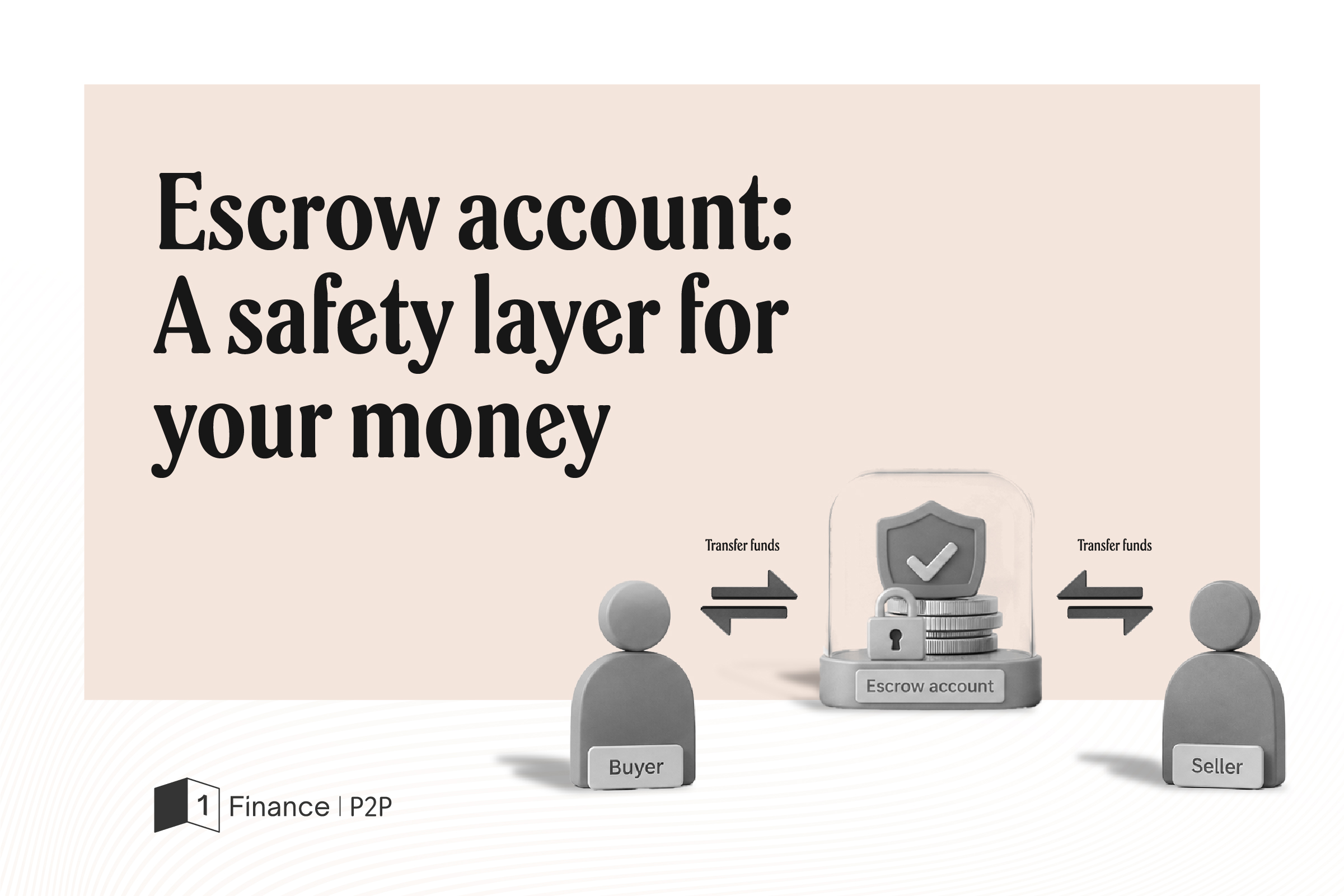
Lending money to a stranger through an app sounds risky until you follow where the money actually goes. When you lend through a peer-to-peer lending platform in India, your funds never sit with the platform itself. It follows a specific mechanism, which keeps your money separate from the platform.
That separation sits at the heart of how P2P lending in India stays safe, and the Reserve Bank of India (RBI) has made it mandatory. The escrow account in P2P lending decides how money travels between lenders and borrowers, and it leaves the platform no way to dip into your capital. Following that money shows exactly where it sits at every stage.
What is an escrow account in P2P lending?
A P2P escrow account is a holding account operated by a bank-promoted trustee that handles the movement of funds between lenders and borrowers on a P2P lending platform. Under RBI guidelines, money received in these escrow accounts must be transferred within T+1 day, ensuring that transactions are processed promptly and transparently.
You may have come across escrow accounts in property transactions, where a buyer's payment is held securely until ownership is transferred. The same principle, a trusted middle party holding money in place of either side, carries straight into peer-to-peer lending.
In P2P lending, the platform helps match lenders with borrowers and manages the loan servicing process, but it never holds or owns the funds. Your money moves through regulated escrow accounts and remains separate from the platform's own accounts. This segregation is an important protection measure and helps ensure that the platform cannot use lenders' funds for any purpose other than the lending transaction.
That said, an escrow account does not guarantee repayment or protect you from borrower defaults. Its role is simply to ensure that money moves between lenders and borrowers in a regulated, transparent, and RBI-compliant manner.
Before mandatory escrow accounts, P2P lending platforms pooled lender money
The industry didn't always work this cleanly. In its earlier days, some platforms managed funds in ways closer to aggregation than a true marketplace, letting lender capital pool in platform-controlled accounts while it waited to be matched. That pooling blurred the line between the platform's money and the users' money.
It occasionally led operators to benefit from the float, or use incoming funds to paper over repayment delays elsewhere. A lender could never tell whether their capital sat idle, was actively matched, or had been redirected to cover another user's withdrawal.
What’s the RBI circular on escrow account in P2P lending?
The Reserve Bank of India closed those gaps through its Master Direction for NBFC-P2P platforms, tightened significantly by a circular on August 16th, 2024. The rules set out exactly how a platform must handle your money, and every registered platform has to follow them.
Every P2P platform must now maintain at least two separate escrow accounts, one holding funds received from lenders and the other holding collections from borrowers. Both are operated by a trustee promoted by the bank that maintains the accounts, keeping the platform's own staff away from the money. Funds received from a lender can only reach the specific borrower matched to them, and a borrower's repayment can only travel back to the lender who funded that loan. Cash is barred entirely, with every rupee moving through bank accounts that leave an audit trail.
A strict timing rule sits on top of this. Money transferred into either escrow account cannot stay there beyond one business day, the T+1 settlement rule in peer-to-peer lending, that took effect in November 2024.
For example:
- If you lend money on a Monday, it must be transferred to the borrower within T+1 day.
- If a borrower repays a loan amount, it must be credited to the lender's bank account within T+1 day.
This requirement ensures faster settlements and prevents lenders' or borrowers' funds from being parked unnecessarily in escrow accounts.
The full RBI P2P lending guidelines cover more ground, though these escrow account rules are what protect your money most directly.
Benefits of P2P escrow accounts for lenders and borrowers
The escrow structure changes what you are actually exposed to as a lender.
Secure transactions: Because a trustee holds your capital, the platform's own financial health has no bearing on the safety of your idle or disbursed funds. The only risk you carry is the borrower's ability to repay, which is how peer-to-peer lending is meant to work.
Regulatory compliance: Every escrow movement sits under RBI oversight, with the trustee and the bank accountable for how the funds are handled.
Increased transparency: The clean, auditable trail lets you see whether your money is idle, matched, or disbursed at any moment, rather than guessing.
No intermingling with the platform: Your funds stay legally separate from the platform's own money, which keeps them from being touched to cover the company's costs or another user's withdrawal.
For a fuller view of the risks that remain even with this protection, read ‘Is P2P lending safe in India?’.
How to open an escrow account in P2P lending
As a lender, you don't open a P2P escrow account yourself, and there's nothing for you to set up. The platform arranges the escrow accounts with a bank-promoted trustee before taking on any lenders, since RBI requires this as a condition of operating.
When you sign up with a P2P lending platform in India and add money to lend, your funds move into the existing lenders' escrow account on their own. The one thing worth doing is confirming the platform is a registered NBFC-P2P, which you can check on its website and against the RBI register.
A registered platform displays its RBI registration number and the mandatory RBI disclaimer on its website and app, and a quick look there tells you the escrow protections above truly apply to your money.
Conclusion
The escrow account in P2P lending turns a leap of faith into a traceable, rule-bound process. Your money moves on a fixed path, and returned to you on a strict timeline, with the platform kept clear of it throughout. That structure removes the platform as a point of failure and leaves you facing only the borrower's credit risk, the risk you chose to take. P2P lending lets you earn monthly returns from borrower repayments, and the escrow makes sure each repayment reaches you cleanly.
Before you begin, reading a platform's disclosures on borrower defaults and past losses matters as much as understanding the escrow that guards your capital. A clear grasp of both is what separates informed lending from a blind leap.

Tejashree Satpute
Tejashree is a Senior Finance Content Writer at 1 Finance, specializing in-depth financial research and content strategy. With over 5 years of writing experience, she turns complex market data into accessible insights. Outside of finance, she enjoys classic literature, poetry, and long walks.